Boxing Up Common Parts of an App
As I look for work, please support me with a donation to the project development I'm spending in the Atmosphere — donate hereI've been working on Shock as I look for work to both keep my blades sharp and to try out some new stacks. Shock's written in Rust and JavaScript (and a little bit of TypeScript)[1] using Tauri to bind a system-provided Web browser view to a Rust library that provides IPC to a JavaScript "frontend"[2]. I had two moments where I could have kept things simple but wanted to experiment.
The Icons
Shock is - first and foremost - an editor[3]. It needs to know where to put and read things and with a sprinkle of SQLite, it's able to do that pretty well. In the flow for setting up a new site, I wanted to give people a way to have some sort of visual identifier for sites. The following truncated code is how I implemented something for folks to select an icon.
<aside class="icons">
{#each iconSet as icon}
    <a
        href="?action=create"
        class="icon"
        class:selected-icon={selectedIcon == icon}
        on:click={() => (selectedIcon = icon)}
    >
        <Icon
            fw
            {icon}
            scale="1.5x"
            style="color: var(--color)"
        />
    </a>
{/each}
</aside>
<style>
  aside.icons {
    display: flex;
    flex-direction: column;
    flex-wrap: wrap;
    overflow: scroll;
    margin: 1rem 0;
    height: 20rem;
    width: 50rem;
  }

  .icon {
    --color: gray;
    margin: 0.5rem 0.6rem;
    border: 0;
    background: transparent;
    padding: 0;
  }

  .icons .icon.selected-icon {
    --color: crimson;
  }
</style>
<script>
  let allIcons = Object.values(fas);

  function* iconGen(amount) {
    let count = 0;
    let pastIcons = [];
    if (selectedIcon) {
      count += 1;
      pastIcons.push(selectedIcon);
    }
    let icon;

    while (++count <= amount) {
      const index = Math.round(Math.random() * 1900);
      const currentIcon = allIcons[index];

      const pastIndex = pastIcons.findIndex((pastIcon) => {
        return pastIcon == currentIcon;
      });

      if (pastIndex === -1) {
        icon = allIcons[index];
        pastIcons.push(icon);
        yield allIcons[index];
      } else {
        --count;
        continue;
      }
    }
  }

  function rollIcons() {
    iconSet = Array.from(iconGen(144));
    if (selectedIcon) {
      iconSet.push(selectedIcon);
    }
    shuffle(iconSet);
  }
</script>
There's quite a bit going on here but before I explain, I want to show you what it results in.
As shown, this renders a region of icons. When you select an icon and choose to shuffle, your selection is kept (though not in the same place) while the rest of the surrounding icons are pulled from the imported icon set[4]. After I wrote this, I considered pulling it out into a separate component. An immediately naive answer would have been "yes!" since it "provides value". But currently, this value is isolated to only this part of Shock. This information doesn't even get saved[5]. However, in implementing this, I got to use a few things I hadn't a real chance to use in work environments.
Generators
While working with Rust code for education and (in the past) Clojure for work, my appreciation for programming that centered around streaming grew. I'm familiar with the concept of generators in JavaScript but hadn't implemented one for something outside of learning until now. The code in reference is the following:
function* iconGen(amount) {
    ...
        yield allIcons[index];
    ...
}
With these two lines, iconGen has gone from a pure function[6] to a generative iterator, which lightly explains
what this allows you to do. I can use this generator to create a list of any number of icons.
In an earlier (and buggier) version, I forgot to remove the currently selected icon from the list and so, made the
generator to make the number of icons dynamically but keeping it isolated (to a degree). Fixing that, I can still
change the number of icons. I didn't move this into a separate component because at the moment,
there's no need to extract something that might require a different presentation implementation elsewhere. What I did
plan on adjusting was the number of icons and keeping the generator allows me to focus on the presentation layer,
refactor the generator out and keeps the functionality in both places - with some help[7].
The Table
As with most software, some sort of list has to be shown. Shock deals with editing pages, themes and the sort so there's
list abound. However, I haven't created a full-on fixture system to emulate dozens of pages so I'm almost always editing
index.html. That didn't stop me from extracting the table used to present items. Excluding the styling and the few
lines of associated JavaScript, here's how they're implemented at the moment:
<form>
<aside>
{#if $$slots.filter}
<button on:click={() => (showSearchPanel = !showSearchPanel)}
><Icon icon={faSearch} /><span>Filter…</span></button
>{/if}
<span></span>
{#if $$slots.actions}<slot name="actions" />{/if}
</aside>
{#if items && items.length != 0}
<div>
<table>
{#each items as item}
<tr>
<td>
<slot {item} name="item"></slot>
</td>
</tr>
{/each}
</table>
</div>
{#if $$slots.filter}
<div id="searchPanel" data-hide={!showSearchPanel}>
<slot name="filter" />
</div>
{/if}
{:else}
<slot name="missing" />
{/if}
</form>This provides a very thin wrapper on listing a set of items in a table. I wanted to avoid too much of the divitis while working on this[8] - still a work in progress. This implementation of a sortable table removes a lot of of styling constraints and leans into what I'm expecting to see the future of Web component development to look like out of the box. I'm a very big fan of using slots, in this case, Svelte's implementation, since they allow you to bring your own elements and styles and lean into reactivity to bridge between them. I found that having this out of the box have improved my ability to produce something both friendly to debugging (since it's state we're tracking and replacing) and simpler (since I can isolate things a lot more).
With that code, I'm able to present the following:
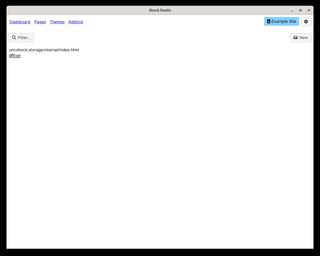
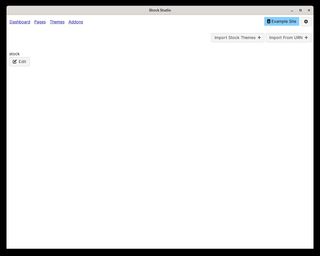
Next Steps
I see myself keeping this table abstraction and adding more styling to the table itself. Introducing some way to add per-row and whole-table behaviors will help for bulk actions. I'm glad that I kept the icons isolated because the way my yak has been asking for a fresh cut, it would have been completely tested with no purpose outside of watching some icon turn red.
There's also a chance for me to bring this table interface to the first screen you see when you start Shock, which currently looks like:
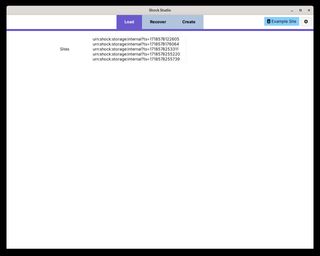
There's lots of room for improvement, though still in its very early phases.
While useful for locking in typing constraints in JavaScript, I find that TypeScript can obscure some of the newer functionality that we have in JavaScript when I'm working on it in a greenfield situation. That option softens when I'm in working contexts as there's more tooling in place but that seems to be part of the problem that's also shopped as the solution. ↩︎
I use "frontend" like this because the term is overloaded. I think of the ActiveX and JavaScript things I built using
mshta.exewhen I last used Windows and that has shaped my perspective on these kind of applications. ↩︎That's the case for now. Over time, you'll see more of the presentation side but I'm going to be focusing on the editor for this post. ↩︎
There's nearly 2,000 icons in the solid set that I'm rolling through here. In the future, I plan to use a smaller, constrained set of icons that aren't so randomized. Suggestions on what icon set to use are welcome — especially friendly, warm and inviting ones. ↩︎
It's not saved yet because I have to figure out where I want to save this information (locally in the application's index of sites? along the site's definition itself?) to both make it optional for use and if used, something that's useful. I personally want this feature since scanning icons versus text is a lot easier for me. ↩︎
I told you I was Clojure-pilled, ha. ↩︎
I didn't explain the
shufflemethod - I looked at the second implementation here; I initially wrote the first one before coming to that link! You can look at its implementation — open to suggestions to it. ↩︎Working on the frontend has taught me that there's definitely not too much respect for browsers provide out of the box. Lots of folks have spoken about our need to decenter and de-myth-ify ourselves when we write for the Web. ↩︎